
Whilst the opening ceremony will not take place until Friday evening, there has already been plenty of Olympic action taking place over the last few days as fans start to warm up to the summer sporting extravaganza, with several team competitions getting underway and nations setting out on the road to what they hope will be a gold medal for their country.
One of the sports that has been taking place is the men’s rugby sevens tournament, and it has provided plenty of excitement for fans to soak in and a number of moments for them to savour. What has particularly caught the attention of those watching is how many teams have looked like having a genuine chance of standing on the top step of the podium, and one that really caught the eye until their elimination was New Zealand.
As their pool stage games against Japan, South Africa and Ireland went on, there was a lot that the All Blacks Sevens did well both with and without the ball, and this tactical analysis will break down some of the main features of their play to indicate why they proved to be such tough opposition on the whole.

The fundamentals of New Zealand’s tactics have always been the same, with them famed for their passing ability and the way that they can go from one wing to the other in a highly co-ordinated manner. As their time at the 2024 Olympics progressed, it was evident just how vital that was to them winning matches, with some outstanding offloads occurring in all areas of the field as they tried to control the flow of their games.
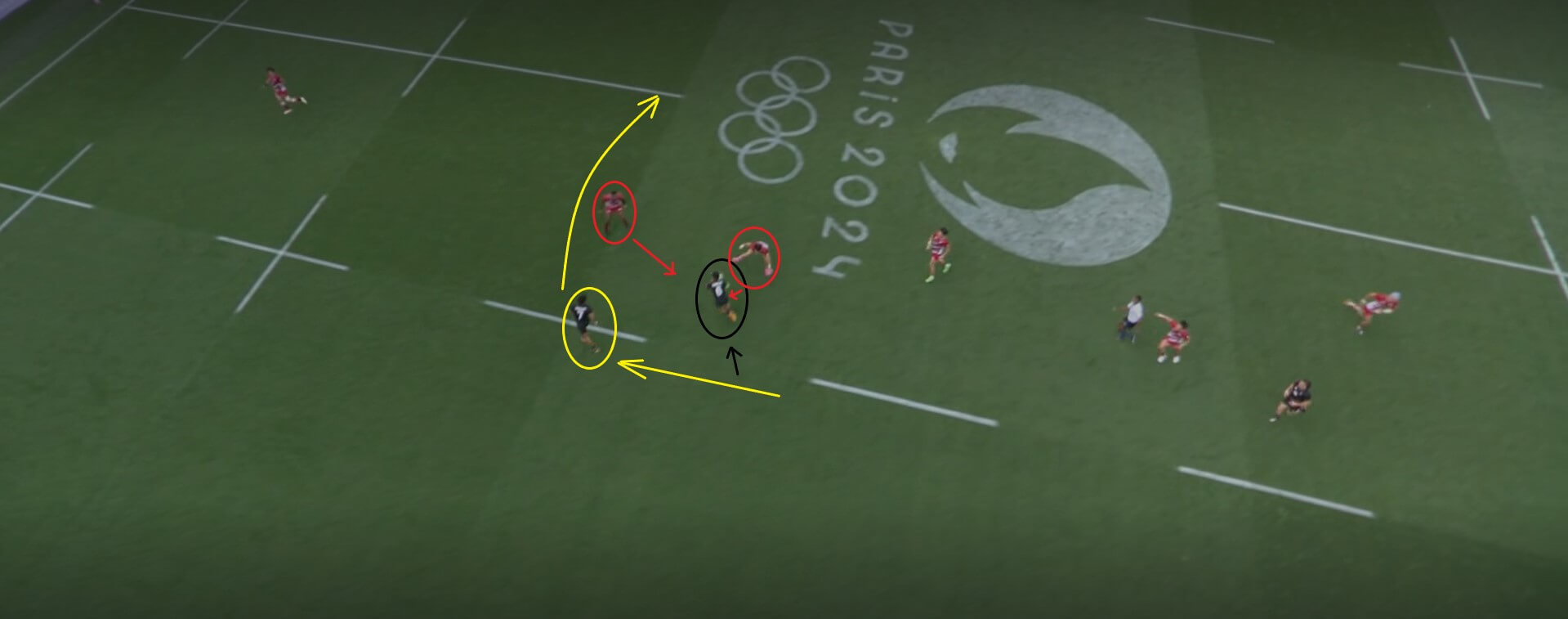
What needs to be pointed out though is that they adapted their game plan depending on who they were coming up against, with each side presenting different challenges and looking to defend in alternative ways. In South Africa’s case, New Zealand recognised that they were coming up against a team whose organisation has been noted in many a scout report, and so their aim was to attack them where they were least expecting runs to be made. It is for that reason that Ngarohi McGarvey-Black has here run up the blind side once the ball had been retrieved from a set piece.
However, this was only part of what led to a try here, with what McGarvey-Black did at this stage central to New Zealand keeping the Blitzboks at bay. As can be seen, the New Zealand player has angled his body as if to insinuate an inside pass, which forces both Christie Grobbelaar and Tristan Leyds to stay inside the pitch, whilst he then sends the ball behind him and allows Andrew Knewstubb to run through and to maintain the attack.
When considering that New Zealand did manage to ground the ball over the line after some more precise passing sequences, it shows how details like this have been so important in allowing them to be so threatening, and it could have been expected that they would have continued to show the same nice touches to their play here and there had they managed to extend their time in Paris beyond the initial knockout round.

The other thing that New Zealand did well is spatial manipulation as they looked to create gaps in their opponents’ lines. This was particularly important in their opening match against Japan, with the latter team seeking to spread out where they could and to cover as much of the pitch as possible when without the ball.
Again, what made this such an effective part of New Zealand’s play is the way that individuals connected with each other and were switched on to what those around them were looking to do, and this was one situation when the positivity that this can bring was especially highlighted. As can be seen, Japan have relatively even gaps between each other and so look to have contained their opponents, but the pass from Fehi Fineanganofo to McGarvey-Black here allows the latter to then run towards the Japanese line whilst the former positions himself to play the supporting role.
By moving towards the line with the same pace shown previously in the analysis, McGarvey-Black succeeds in committing the two defenders closest to him into making a tackle and so leaves enough space open for Fineanganofo to then carry the ball through, and the fact that this ended in a try under the posts highlights how this ability to force opponents out of position was just as important in allowing New Zealand to be at their devastating best.

It was not only in attack where New Zealand tried to be proactive though, with them looking to be just as front-footed when out of possession too. In this case, Japan have the ball and are looking to move it out to the far side wing, but McGarvey-Black has moved out to shut the ball down and so forces them to offload it prematurely, which sees the ball go loose and hit the ground before it can reach Takamasa Maruo.
This is where the positioning of Leroy Carter comes into the equation, with him anticipating the loose pass and ensuring that he can react as soon as it materialises. As a result, he manages to get out to Maruo and to prevent him from releasing the ball, with Japan ending up conceding possession momentarily before regaining it due to New Zealand knocking the ball forward in the ruck.
Whilst mistakes like that hindered the All Blacks in all of their group games and ultimately led to their exit from the tournament in the initial knockout match, the intent in their play was very clear to see and there was a lot to like about their performances overall. If they could have navigated a way past South Africa in that aforementioned knockout stage and could have continued to operate with the same clarity of thought and unity around the field, then they could have proven to be really tough opposition. As it is though, their time in Paris has now ended and it will feel to some as though one of the initial frontrunners saw their competition ended prematurely.