
Whilst South Africa are the reigning world champions and are considered by many fans to be the toughest side to play against at the current time, their performances on the domestic front have not been as impressive, with all four of their teams encountering mixed form at one time or another in the current United Rugby Championship season and only one getting beyond the quarter-final stages of a European competition (with the Sharks reaching the European Rugby Challenge Cup final, where they will face Gloucester).
The side who have been the most consistent and arguably the strongest of the four has been the Bulls, who have made a big improvement on last season’s fortunes and who currently sit fourth in the URC table, and they have constantly looked like a tough team to come up against every time that they have stepped out onto the pitch.
Central to that has been their style of play, which revolves around them getting on the front foot early and on making the ball do the work, and one player who has been a key reason for that being so successful is utility back David Kriel. Mainly operating as a centre, he might not be a name that immediately springs to mind among some fans, but he is a player who has been a major threat both with and without the ball, as this brief tactical analysis will detail.

Whenever watching the Bulls play, it is clear that every player in their team needs to match a certain profile and to offer certain characteristics, several of which rely on their ability to move the ball around the pitch at speed and to ensure that the fast-paced tactics referenced earlier in the scout report are as effective as possible.
To make that possible, players have to think quickly and to react early to chances to break through opponents, and that is something that Kriel has been especially prominent at as the campaign has gone on. As is the case here, he has tended to run a number of hard lines and to get as close as he can to each breakdown situation, which then gives opponents less of a chance to set up their defensive shape and therefore increases the Bull’s chances of breaking through gaps in their lines and of scoring tries.
In this case though, Zebre have managed to retain some cover in the backfield and so, despite Kriel making another quick run that has taken the majority of the home side’s players out of the game, he is not able to finish the move off on his own. However, this is where another aspect of the Bulls’ strategy comes in, with Kriel knowing that he has versatile back Devon Williams alongside him and so working with his teammate to create a 2-v-1 situation. By slowing things down here, he forces Zebre to commit to tackling him, and it is that stage that he releases Williams and allows him to take the ball over the line.

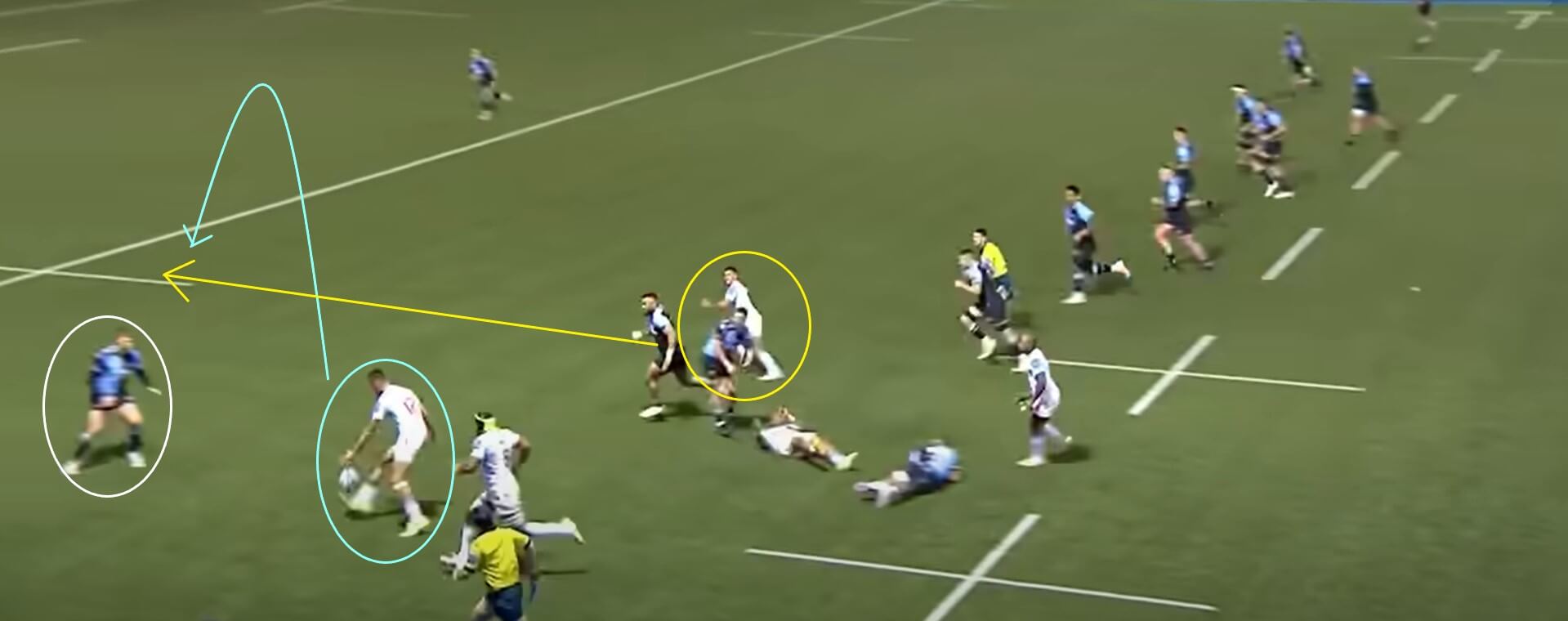
The timing and quick-thinking that was highlighted in that situation has been common to see whenever Kriel has been in possession, and another way that he has demonstrated his general speed of thought has been when adapting between different ways of moving the ball up the field. In this case, it has been shifted into his path and he has initially shaped as if to make another strong carry up the pitch, but Cardiff full-back Jacob Beetham has got out to close his route down and to limit his options.
This, however, only allows Kriel to demonstrate another side to his game, in that he is capable of making sharp changes of direction and of kicking with a high level of accuracy. In this case, it can be seen how he is already angling his body as if to run inside Beetham and he then puts boot to ball and sends it into the space ahead of him, taking the Cardiff player out of the game and allowing scrum-half Embrose Papier to run through and to ground the ball over the line.
These qualities are what has made Kriel such a dependable player for his side, with the Bulls using him in effect as a secondary playmaker whenever they have been in attack, and his presence and ability to find teammates in different areas of the field has certainly contributed to the likes of Canan Moodie and Kurt-Lee Arendse having plenty of chances to get points on the board.

It is not only in attacking situations though where Kriel has proven his worth to the Bulls, with the Pretoria side benefitting from his defensive attributes too. Again, as has been a theme throughout the analysis, there is a certain style in which they have looked to defend and everyone in the team needs to conform to it, with there being a clear desire in every match for them to press forward and to limit the amount of time that their opponents have to find each other with the ball.
However, it is not only about getting tight to individual players but also about taking up positions between the line, which is what has made the Bulls such a difficult team to beat. As is shown here, this is another thing that Kriel has been constantly adept at, with him winning the ball in the air here once Ospreys tighthead Rhys Henry had tried to find loosehead Gareth Thomas and then attacking the territory that had been left open behind the Welsh side’s line.
As was the case in the first situation, Kriel was unable to finish the chance off on his own due to opposing number Owen Watkin closing him down, but he once again had support through the aforementioned Moodie and the Bulls were therefore able to convert the opportunity into valuable points.
It might appear as if Kriel is simply a creator and is not someone who scores many tries, but that would be an incorrect assumption to make, with him getting over the line on six occasions to date in the URC. Therefore, when combining that with the points made in this analysis, there is no doubting his overall importance to the Bulls’ play and their hopes of ending the campaign on a positive note. It is of no surprise either that he has been linked consistently with a Springboks call-up, and it might not be too long on the basis of his performances this season before he is seen in the famous green and gold shirt.