
For the United Rugby Championship’s defending champions Munster, 2023/2024 has been a slow burner so far, with them beginning in a lethargic manner and experiencing a few bumps in the road early on before rediscovering their form and forcing themselves back into the play-off conversation as the campaign has gone on.
Their improvement can be attributed to some excellent individual performances, and those who have rightly attracted headlines and attention from higher levels have included the Ireland trio of scrum-half Craig Casey, fly-half Jack Crowley and winger Calvin Nash as well as lock Thomas Ahern, with them all working hard each week to ensure that Munster’s fast-paced tactics have had the desired effect.
However, one player who has offered a lot to their play and yet who hasn’t often got the credit that he deserves is versatile forward Gavin Coombes, and yet, as this brief tactical analysis will indicate, he has been so central to Munster’s play of late and has often been the one that has kept things ticking over around the field, and there is little doubting that they would struggle to function in the way that they do without him.

When watching any team at breakdown situations, what normally happens is that the scrum-half digs the ball out on the ground and then feeds it to one of the quicker or more creative backs, allowing the ball to be shifted into space and to present opportunities for others outside that player to then exploit gaps that have been left open.
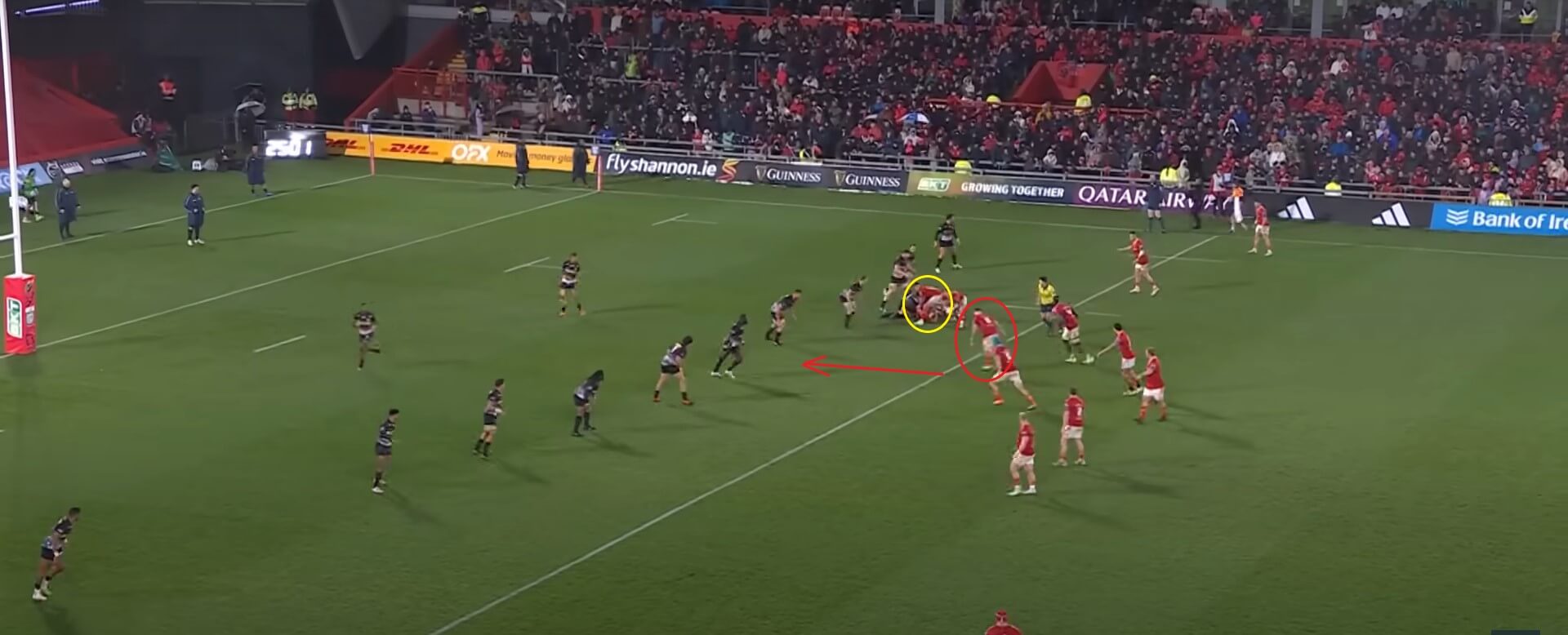
However, for Munster, it is often the case that Coombes is that first receiver, and he tends not to possess the same skillset and instead likes to get on the ball and to drive forward in a bid to gain as much territory for his team as he can. This is shown clearly here, with Casey fishing the ball out and immediately feeding it to the number 8, who then runs towards the Stormers line without a moment of hesitation.
What has been key to making this so successful for Munster is the understanding that has developed between Casey and Coombes, with them constantly linking up with each other and working in unison to ensure that they can recycle the ball and then hit teams where they are least expecting it. On this occasion, it didn’t lead to anything of note as the back rower was quickly forced to the ground by loosehead Sti Sithole and substitute lock Adré Smith, but the intention was there and it provides a clear demonstration of what Coombes’ role in the Munster game plan is and how central he is to it.

However, where he has really stood out is when attacking in tighter areas of the field, with many analysis pieces highlighting the danger that he poses to opponents inside their 22m area. In these spaces, he can really be at his wrecking-ball best, with him again offering himself as the initial passing option and then striving to get as far over the gain line as he can.
What makes him so destructive in these moments is his positioning and awareness but also his intelligence, with it clear to see that he starts his run here at the moment that Casey gets his hands on the ball and not when he turns to pass it. As a result, when the scrum-half does look to shift the ball either side of him, Coombes is already mobile and has therefore built up his momentum, and the result of that here is that he powers over the Dragons try line and makes it impossible for them to hold him back.
This is not to say that he wouldn’t have scored if he had waited for the pass to be made before running forwards, but it certainly helped that he was already in motion when Casey released the ball, and it is that that has enabled Munster to play so many flat, fast passes and that has led to Coombes being such a handful in these situations.

However, what is important to note in this scout report is that Coombes is not only a player who carries and who devastates opposing defensive lines, because he can also play the team game and can work with those around him to create opportunities in other areas of the field.
This is again where his intelligence comes into play, with him here receiving the ball but making no attempt to move forward. Instead, having scanned the area around him, he opts to send the ball along the line and towards Crowley, who is circulating behind him.
This shows again how he has been such a good fit for Munster’s tactics, with him capable of making the quick passes that they depend on and recognising when it would not be the best policy for him to take matters into his own hands. The fact that his pass here led eventually to the ball being grounded in the corner by Ahern shows how this intelligence and decision-making has often led to positive moments, again highlighting how vital he has been to Munster’s play.

It is not only about attacking though and he, like the rest of his team, have needed to work hard to keep teams out as the season has gone on, and that is where he has struggled at times.
However, where he has shown a particular indication of his quality is when defending on the front foot, with him here seeing fellow back-rower Alex Kendellen take the ball to ground and Scarlets frantically try to recover the ball as they seek to prevent their try line from being breached.
To ensure that a jackal doesn’t happen, Coombes joins his teammate and puts himself in the way of Scarlets’ substitute back Steff Evans, preventing him from reaching the ball in time and offering Kendellen the protection that he needs. As a result, Casey was able to fish the ball out and to set up another chance for Munster to drive at the line rather than seeing the attack fizzle out and the ball sent back towards his own half.
It might not look like much, but it is these small details that often go unnoticed in games, and yet they so often make the difference between teams winning and losing them. Therefore, Munster will always benefit from having a player with the collision ability and work ethic of Coombes on the field, and there is no doubting that he has played his part in the province fighting their way into strong play-off contention as they seek to defend their URC title.