
Ever since its inaugural season in 2018, Major League Rugby (MLR) has gone from strength to strength, with the number of teams entering it increasing as each year goes by and the attention given to it by both broadcasters and general audiences also growing as more and more people in the USA embrace what it offers.
One team who have been around since the very beginning are Seattle Seawolves, with them winning the league on two occasions (2018 and 2019) and finishing as runners-up in 2022. With them being the most successful team in the league, there will always be an expectation that they will be challenging for honours each campaign, and, whilst they missed out on the final last time out after losing to San Diego Legion in the Conference finals stage, they do seem to be in a good place to compete for the trophy once again this time around.
At the time of writing, they sit at the top of the Western Conference, having won seven of their eight matches and having accumulated the most points after eight matches (33 to date), as well as sitting second in the rankings when it comes to in-game points after scoring 250 (Chicago Hounds are the current leaders, having scored four more). All is looking very positive for them as a result, and this tactical analysis will take a closer look at the team coached by former Ospreys boss Allen Clarke to see why their tactics have been so effective and why they have been such tough opponents to come up against.

When it comes to Seattle’s overall game plan, the fundamentals of it are not that difficult to work out, with it clear that they always want to play on the front foot and to gain as much territory as possible whenever they have the ball in hand.
To make that work, their aim is to constantly make flat passes, with this situation showing scrum-half Ryan Rees sending the ball across the pitch and towards Dan Kriel, but not directly to him and instead into the open space ahead of the centre. By doing so, Rees invites his teammate to build up his speed and to run onto the ball whilst on the move, knowing that having that momentum will give Kriel a better chance of breaking through the Miami Sharks line and of taking the ball a long way up the field before being forced to recycle it. In this case, it works to perfection and Kriel ends up making a number of metres before the Sharks eventually bring his individual attack to an end.
The other positive that comes out of this tactic is that it sucks more players towards the ball and so leaves further gaps open in other areas. That is the other thing that the Seawolves are constantly looking to create, with them here entering a multiphase period as they make several passes and carries which eventually leads to winger Jade Stighling breaking through on the far side wing and scoring a try.
Whilst it largely worked well for them in this game, it should be remembered that this is not a style that comes without an inherent amount of risk, and what Seattle have fallen foul of at times is that they have sometimes made these flatter passes without assessing their surroundings first. As a result, those teams that have pressed higher than Miami did here, such as Chicago and Houston SaberCats, have both been able to make easy interceptions at times and have profited from those lapses in concentration. However, on the whole, this has never troubled Seattle too much and instead it has been one of the key reasons that they have been so effective in possession.

The other thing that has been noted about their play is that there is a good amount of variety in how they can set up around the field, with them having several types of players who all bring different qualities to the table and who can rotate as needed. In this case, that is shown through versatile back Sam Windsor, who has often played at inside centre but who featured at his more common fly-half position against Los Angeles due to regular standoff Mack Mason being absent with a slight injury.
Ordinarily, Windsor’s role in the midfield has been to make dominant carries and to break through opposing lines, but he also has an ability to be creative at times too, which comes from those games when he has featured at fly-half. The fact that he can play in both roles and can almost combine the best of them leads to this situation, when he has received the ball and looked as if he would move it down the line towards Kriel, who was outside him and in acres of space, but instead used him as a decoy and opted instead to use his strength and to attack the try line on his own.
With this not being what LA were expecting, their ability to defend against Windsor here was severely compromised, and all three of Bruce Kauika-Petersen, Rory van Vugt and Niall Saunders were unable to prevent the Seattle player from grounding the ball over the line here.
It might not look like much variety is on show, but that comes through Mason not necessarily looking to make the same penetrating carries, and so that demonstrates how Seattle have been able to mix things up at times and have as a result been able to make their wins look very easy.

The other thing that has been a constant in Seattle’s play has been their desire to not engage in team drives at set pieces, with their aim instead being to recycle the ball as early as possible and to catch their opponents out. This has particularly been the case at lineouts, with the example earlier in the scout report showing them passing the ball early to access the space before it could be closed off, and here the ball found its way back to USA hooker Joe Taufete’e without anyone holding onto it for too long.
The reason for that is that Taufete’e has no intention here of driving through the middle and is instead searching for a chance to break away from his teammates and to score in the space to his right, where he knows that he will have the element of surprise on his side and that Utah Warriors will find it difficult to stop him. In this case, it worked to perfection for him, with Utah seemingly unaware of his intentions and so not prepared to stop him when he did make his move, meaning that he successfully evaded both opposite number Nic Souchon and former Newcastle Falcons fly-half Joel Hodgson and was able to ground the ball without being under any significant pressure.
This is not to say that the Seawolves never use their combined driving weight in these situations, with there being some games when it is necessary to not overcomplicate matters and to simply execute the basics well. The game against Houston (which is so far Seattle’s only defeat in 2024) was one of those, with the SaberCats working hard to limit the effectiveness of their key tactics and Seattle therefore had to get their points through rolling mauls. Therefore, there is again variety in their play and an ability to rely on different methods of getting points on the board, which has again helped them to stay in control of the Western Conference.

This is not to say that everything about them has been perfect though, and the fact that they have conceded 176 points so far (an average of 22 per game) means that the defensive side of things is one of the areas where they can still tighten things up.
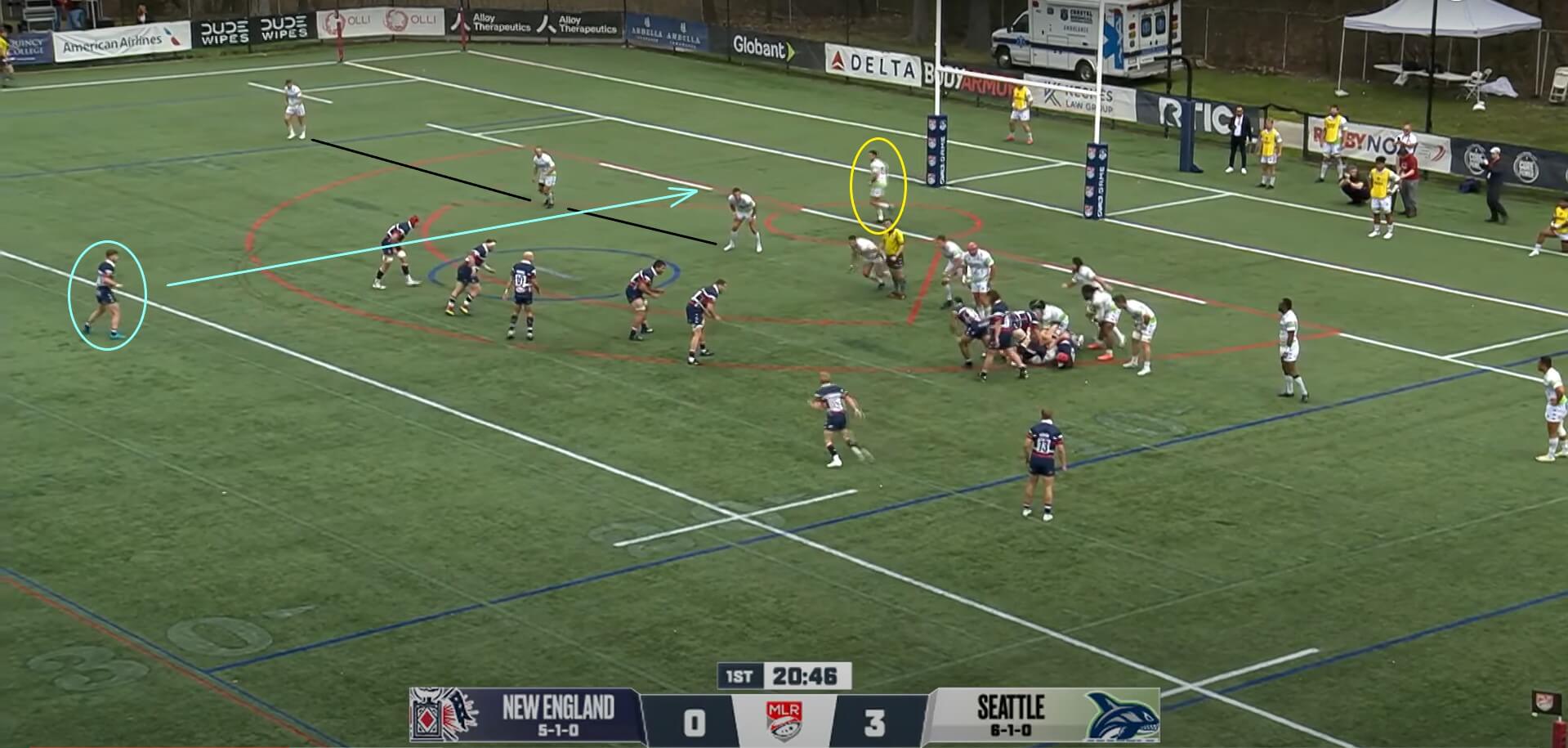
The key reason that they have tended to be easy to score against at times is because they have a habit of leaving themselves too exposed when it comes to setting up their defensive line. That issue is shown clearly here as defending champions New England Free Jacks look to attack on the nearside of the field and the Seawolves are aiming to prevent them from gaining any access to their try line.
However, where the problems lie here is that, whilst Seattle have looked to seal off any chances of New England making quick sniping runs around the fringes of the breakdown situation, they have doubled up in those areas and so have less players available to guard the outer reaches of the field. As a result, their line has become threadbare and there are sizeable gaps between each of the defenders, which New England have realised and have looked to exploit by shifting the ball across to that side of the pitch.
The space that they had here meant that, much as Seattle did at the beginning of the analysis, the Free Jacks can pass the ball in a flatter manner and so can allow their quicker players to build up momentum before they get their hands onto it, and that ability to accelerate towards the line is what ultimately leads to centre Wayne van der Bank getting over the line here. He was helped by Seattle’s Namibia utility back Divan Rossouw slipping in his efforts to block his route, but the speed at which the New England player was travelling at means that a try would likely have come about even if he had managed to keep his footing here.
Therefore, whilst there is a lot to like about Seattle’s attacking play and the way that they have managed to break their opponents down, there are still a few cracks that need to be addressed if they are to lift the MLR title again this year. It won’t be easy, given that there is now even greater competition for the prize, but they have the quality required to get their hands on it and it will be interesting to see if they can stay in the fight as the campaign goes on.