
When the Italian Rugby Federation made the decision before last year’s Rugby World Cup to part with head coach Kieran Crowley at the end of the tournament, there were many who expressed their surprise after the job that he had done and there was a general consensus that the New Zealander deserved better.
However, as the 2024 Six Nations Championship has gone on, there has also been a growing belief that former Argentina fly-half Gonzalo Quesada is the perfect person to continue building on the foundations that Crowley laid down, with his successor speaking openly before the tournament about wanting to keep the same attacking mindset but without sacrificing defensive solidity, as has often been Italy’s weakness in the last few years.
There is no doubting that Quesada’s methods are having the desired effect, and this tactical analysis will take a closer look at how he has tweaked all areas of their play during his short time at the helm and why Italy have as a result been a much tougher team to come up against, with them on the brink of securing their most positive Six Nations finish in a long time.
Attacking threat
As mentioned, where Italy have most improved in the last few years is in their attacking play, with it clear that both Crowley and Quesada have wanted them to be as expressive as possible whenever they have the ball and to show confidence and quality in order to make the most of the opportunities that come their way.

It was clear from the outset how this would look moving forward, with them constantly on the front foot in their opening match at home to England and arguably the better side on the day.
Their key principles in that game did seem to revolve around negating the blitz defence tactics that the visitors have become so associated with as the Championship has gone on, and it was clear that what Quesada had stressed before the match was a need to keep the ball moving and to never allow any one player to become isolated and closed down by England’s intense press, with him knowing that doing so would only allow the opposing side to gain field position and to then use that to expose weak areas in his team.
Playing with that mentality instantly lends itself to the more creative players in the side, and one who really thrived in implementing that game plan was fly-half Paolo Garbisi, who has undoubtedly been one of the unsung heroes of the Six Nations and has had another tournament that demonstrates why he is rated so highly by so many around the world.
However, it is not only his kicking from the tee that has been so reliable, because he has also shown a good spatial awareness and an ability to locate spaces and to use them to his team’s advantage, with him here spotting a gap in the English defensive line and feeding the ball towards centre Juan Ignacio Brex before then circling back to receive the return pass in an area where he can then target that gap.
In this case, his intelligence and awareness allowed Italy to get beyond England and to score a try through Tommaso Allan, and so there is no doubting that Garbisi has played a key role in getting his team onto the front foot and in allowing them to make the most of their time in possession.

As the tournament has gone on, Italy have looked to build on those basics and have introduced new layers to their play, and one thing that has become common is to see them adapting between game plans depending on who they are facing. Against England, they needed to focus on shifting the ball at pace, but they knew that France would not defend on the front foot and so there would be more opportunities for them to carry the ball forward and to try and get it beyond their line before releasing it in either direction.
That is shown clearly here through lock Niccolò Cannone initially shaping to pass the ball before then taking it into contact, with him eventually being tackled by flanker Paul Boudehent, but what he does before hitting the ground is to feed the ball out to the next player in the line and to allow them to exploit the gap that has now been created through him absorbing the pressure.
Again, it comes down to awareness of their surroundings and being able to create and exploit gaps, and the fact that this chance led to Italy breaking through and setting up full-back Ange Capuozzo to ground the ball over the line in the corner indicates once again how there has been a lot more positivity running through Italy’s play during this year’s Six Nations and that they hold no fear about who they are coming up against.

Whilst ensuring that they are accurate with the ball has been a team effort, there is no doubting that individuals deserve to be highlighted, and two players who have contributed a lot over the last four games are Tommaso Menoncello and the aforementioned Brex. As the weeks have gone on, they have formed one of the most formidable midfield partnerships and have given the team so much balance with and without the ball, and there is no doubting that Italy would not be in the promising position that they are in now without them.
Their partnership was essential to Italy securing a deserved win against Scotland in Rome, ending their long wait (going back to 2013) for a home win in the Six Nations, with Menoncello constantly offering himself as a first receiver at the breakdown and using his pace to push opponents back whilst Brex then made full use of the gaps that were created as a result of those drives to ensure that Italy made significant territorial gains every time that they got on the ball.
It does seem like Quesada has found his perfect midfield partnership moving forward and that the skillsets of both players will enable him to fully deploy the attacking brand of rugby that he wants to see from his players, and there is no doubt that Italy will need both to be just as sharp and dynamic in Cardiff this weekend if they are to secure back-to-back wins and to avoid the wooden spoon for the first time in nine years.
Defensive tactics
Where Italy have really had to work hard under Quesada is when they lose the ball and are put under pressure, with it clear under Crowley that that was where they often allowed opponents to score too easily or to apply pressure, and yet that too has looked sharper in this new era.

The same mantra has been present in defence as in attack, in that there has been a desire to get the basics right and to then go from there, and the key fundamentals of defending in rugby are that teams need to have an even defensive line across the field that doesn’t allow opponents any opportunities to break through them.
Against Ireland, they showed that they had really worked hard on getting this part of their game right, and they did for the most part make the defending champions work hard for each metre of territory that they gained. Here, their setup is clear to see and Ireland have been forced to go through multi-phase play due in their bid to break Italy down, and the fact that it took a number of pushes for them to find a way through shows that, whilst there are a few teething problems that still need to ironed out, Italy do have a basic grasp of what they need to do in these situations in order to not concede as many cheap points.

There has also been a desire to introduce new ideas to their defensive play too, with one thing that has been particularly noticeable being Italy’s desire to double up against their opponents and to defend on the front foot. This was in play from the first whistle, with England needing to work hard to beat their hosts’ intended press and often forced to pass the ball earlier than they would have perhaps liked to.
In this situation, Italy were caught out through Brex and captain Michele Lamaro closing down England full-back Freddie Steward but seeing number 8 Lorenzo Cannone and Lorenzo Pani team up against centre Fraser Dingwall rather than his Northampton Saints teammate Tommy Freeman, and that proved to be a costly mistake as the winger was then able to break through the gap that was created and to then set up Elliott Daly to score.
However, the setup is there and the players are clearly on board with the principle of this way of defending, and there is no doubt that it could work really well for them with a little more work to ensure that they don’t commit too early and leave themselves as open as they did here.

It was clear in that opening round of the tournament that Italy were still developing into an effective defensive force, with there being plenty of mistakes like the one made here, when they seemed to forget the threat posed by England scrum-half Alex Mitchell and left him too much room on the far side to run at Menoncello, leading to a try, and so it will be a work in progress and a project for them and for Quesada.
However, what will please them as a collective is that moments like this have become less prominent as the Championship has gone on, and so there are clear signs of progression, as many analysis pieces have pointed out, and that will give them and their fans hope that they really are moving in the right direction under their new coach.
Speed of thought
Whilst the scout report has highlighted a number of ways in which Italy have looked to develop their attacking and defensive play, one thing that has been a constant across both sides has been their speed of thought, with that being what really makes them a threat.

This has been demonstrated in plenty of ways as the tournament has gone on, and something that has featured regularly in their play is their hard work at the breakdown as they look to secure possession on the ground and to win as many turnovers as they can.
This is not new to their game, with it being something that they did a lot of under Crowley too, and there is no doubting that it was essential in them securing victory on that momentous day at the Principality Stadium two years ago as Wales looked sluggish and didn’t react as quickly whenever the ball did hit the ground.
It has proven to be just as effective this year too, with Italy’s confidence allowing them to really use their strengths to their advantage, and the fact that this turnover by back rower Manuel Zuliani following his tackle on France back Yoram Moefana led to Italy having a chance to beat their hosts once again showed how Italy are always looking for those opportunities to get on the ball and to put their opponents under pressure.
As it turned out, the subsequent kick by Garbisi came back off the post, meaning that the match ended in a draw, but the way that Italy showed determination to win the ball here highlights how effective they are at the breakdown and why their speed of thought and ability to react quicker than their opponents has allowed them to make serious improvements over the last few years.

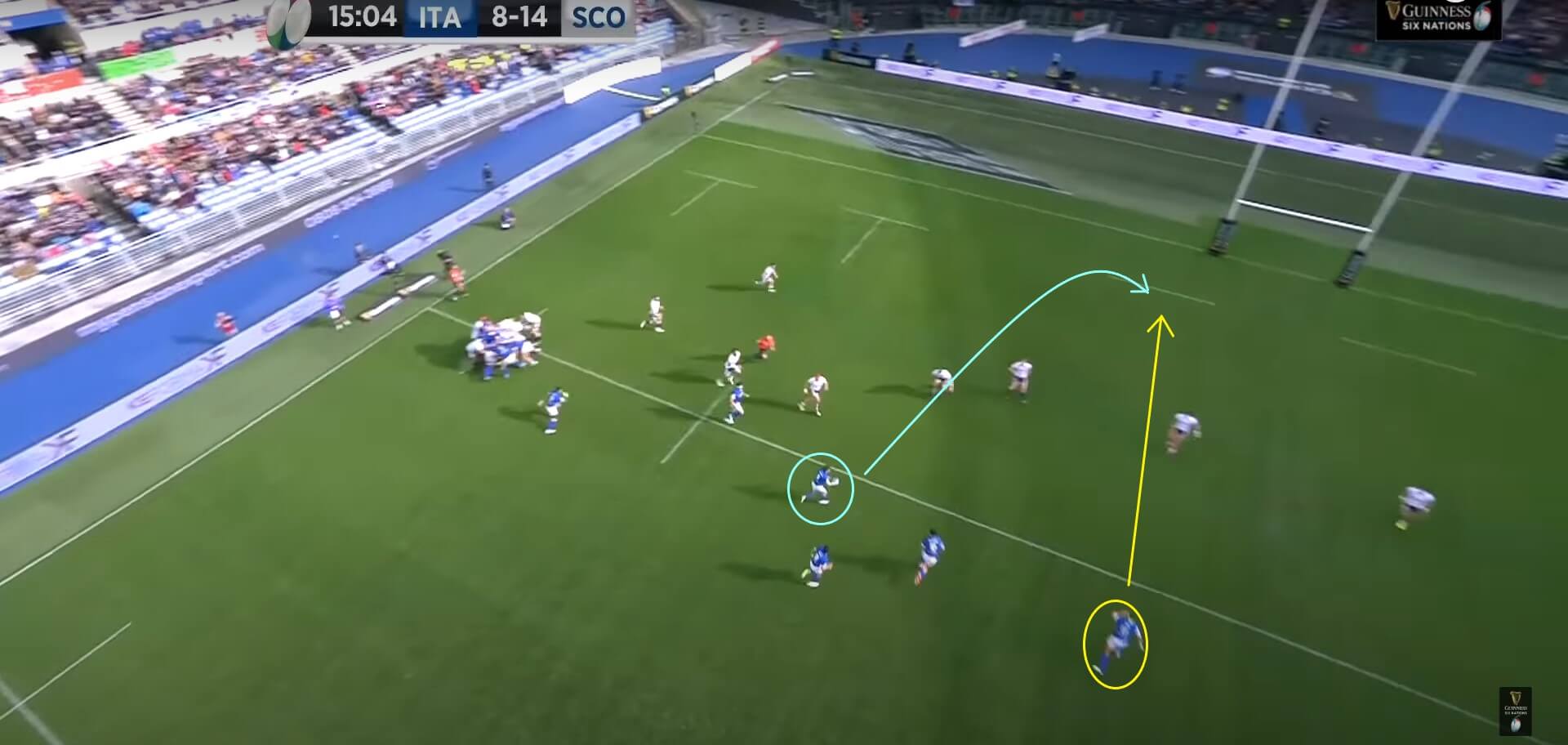
It has been shown in other ways too though, with Italy also demonstrating an ability to think quickly at set pieces and to look to exploit gaps before they can be sealed off. It has already been shown how that helped them to put England under pressure, and there was no doubting that getting the ball forward and thinking a lot quicker than Scotland did was key to them securing a win against Gregor Townsend’s side and staying in the match when it looked as if the visitors were in control.
In this case, the ball has been thrown into the lineout and Scotland have expected that Italy will look to push forward as a unit, but that is not in their plans and instead hooker Giacomo Nicotera quickly recycles the ball and moves it out to scrum-half Martin Page-Relo. At that point, Scotland have a threadbare setup with holes all over the place, and a well-weighted kick by Page-Relo leads to Brex running through to score.
It was a simple try when watching it happen, but that was only because Italy knew what they wanted to do and everyone played their part, and it was also down to them getting the detail of their play right in order to not allow Scotland any opportunity to get back and to thwart their attempt to ground the ball.
It certainly gave Italy a lot of confidence as the game went on, with more kicks coming about afterwards as they realised the damage that they could do, and it again shows how Quesada’s side are constantly thinking and often a few steps ahead of their opponents.
Conclusion
In conclusion, this tactical analysis has looked in detail at Italy and at the reasons for them being such an improved side during the 2024 Six Nations Championship, with them playing with a lot of confidence at the moment and on track for a strong finish to what has been a very positive campaign.
When breaking down the various elements of their play, what becomes clear is how hard they have been working as they try to ensure that they are as well-prepared as possible for whatever they come up against on the field. The detail that has gone into their training and preparation has really been paying off when it comes to their overall performances, with England, France and Scotland all finding it tough to play against them and potentially losing to them on other days, whilst Ireland had to work hard to create opportunities despite winning comfortably in the end.
Their final match sees them travel to Cardiff to face Wales in what is a wooden spoon decider, and Italy will be the favourites to take another victory in that match and to repeat the feat that they achieved two years ago on a day that will never be forgotten by any rugby fan. Given the overall quality of their play and the clear confidence surging through the squad at this moment in time, it seems entirely feasible that they could secure back-to-back victories and there is certainly a lot to be optimistic about when looking to the future.