
When looking at the 2024 Women’s Six Nations table ahead of the final two rounds of matches, there is a familiar feel to it, with the top two positions being occupied by defending champions England and by France (the latter sitting just one bonus point behind after both have won all three of their games to date).
However, where things get interesting is when looking at who currently occupies third place, with Ireland the side sitting in the “best of the rest” position ahead of Round 4 after picking up a win against Wales in their last outing and ending a seven-game run of defeats in the process. It was no more than they deserved after the strides that they have been making on the field, and there is a definite feeling of positivity around the team at this moment in time that new head coach Scott Bemand can take them to new levels.
With that in mind, this tactical analysis will take a closer look at how Bemand has evolved Ireland’s tactics and has made them a much tougher outfit to come up against, breaking down how their attack and defence has evolved and showing why they are on the right track ahead of the 2024 WXV tournament and a potential Women’s Rugby World Cup campaign next year.
Tactics in possession
When comparing Ireland now to before, the most noticeable difference is the clarity that they now display, particularly when they have the ball in hand. That is not to say that Bemand’s predecessors overcomplicated matters but is more of a nod to how he has stripped things back and has ensured that every player understands what is expected of them in every situation, and it is that that has led to them playing with more confidence and belief in what they are being asked to do.

One of the key demands of Bemand’s tactics that has been prominent is the desire to kick whenever possible and to keep putting their opponents under aerial pressure in dangerous areas of the field. When looking at the makeup of Ireland’s squad, this is something that has really suited creative players like fly-half Dannah O’Brien, with her being able to make full use of her ability to identify space and to set up chances for those around her.
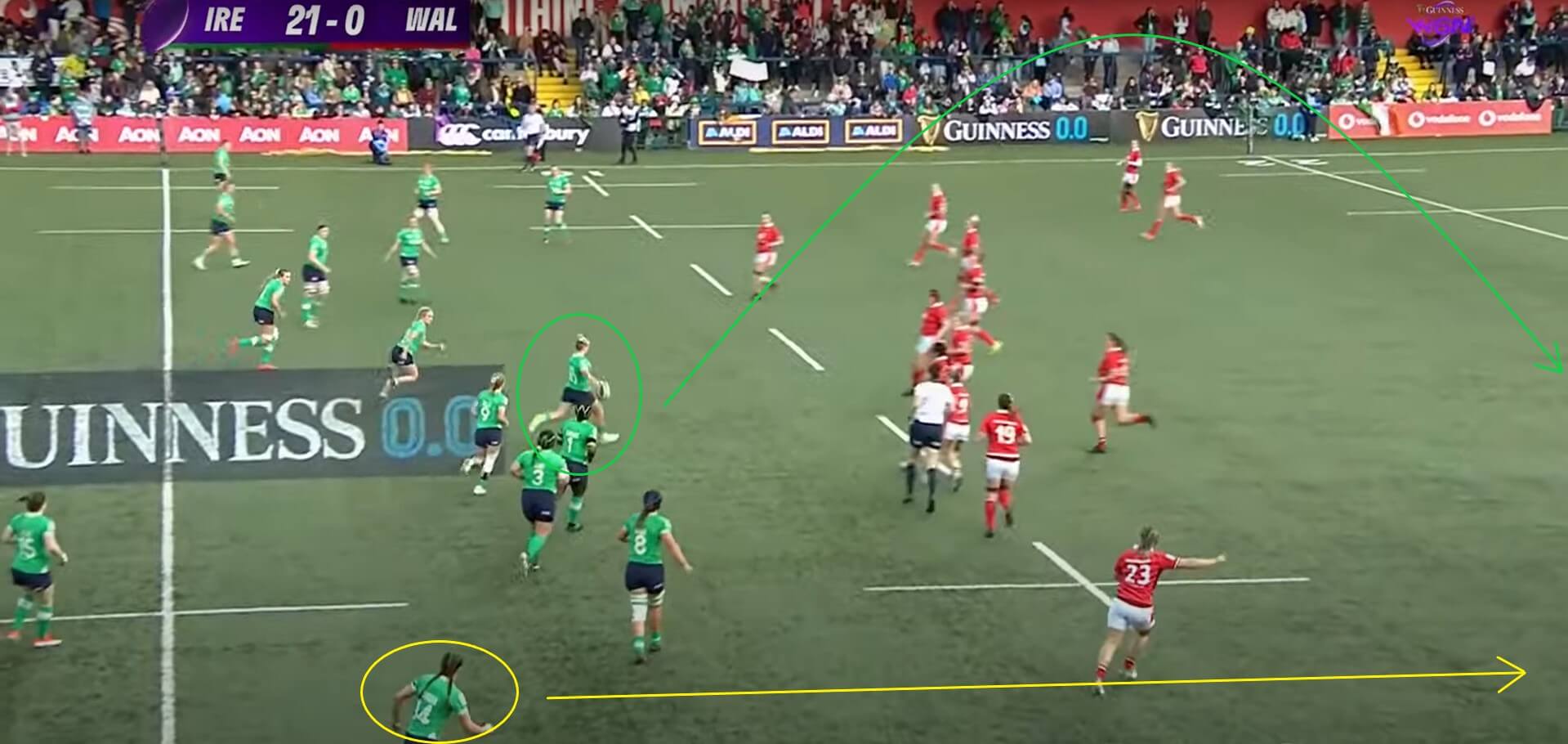
However, it is not simply about hitting and hoping, with Bemand wanting to use the confusion that the kicks create to instigate a kick chase, and that is where this aspect of their game plan has really given them rewards around the field. In this case, O’Brien has received a poor clearance from Wales and has instantly sent the ball back towards their try line, using the windy conditions on the day to her advantage, and the fact that those defenders in the area are focused on the ball means that they aren’t aware of speedy winger Katie Corrigan getting up the pitch to close them down.
As a result, Wales fly-half Lleucu George gathers the ball and immediately attempts to clear her lines again, but sees her effort charged down successfully and Corrigan then uses her momentum to reach the loose ball first, scoring the try. This is something that has worked out for Ireland on a number of occasions, and, whilst this one was down to Wales making a bad mistake, Bemand’s side still deserve credit for forcing the error and for then taking full advantage of it.

This is not to say though that all Ireland do is to kick up the field, because there have been numerous methods that they have used when it comes to making territorial gains. Another that they have utilised quite often has been their ability to carry through gaps and to get over the gain line, as is happening here when flanker Aoife Wafer has the ball and space ahead of her that she can use to her advantage.
This situation came after a period of several phases of dominant carries by Ireland in which they looked to penetrate the Welsh defensive line and to continually suck more and more players towards each breakdown, and it was something that worked for them as the visitors now have minimal protection on the wings.
As a result, they are at this moment rushing across to try and prevent Ireland from scoring in the open space that has subsequently appeared. However, they are in a tricky position due to winger Jasmine Joyce needing to cover the dual threat posed by Beibhinn Parsons and by Wafer, and it proved to be too much for her to manage in the end as the latter was able to run between her and inside centre Kerin Lake, shrugging off the latter’s attempt to halt her advance, and to score the try.
Again, Wales will have come away knowing that they could have dealt with this attack in a better manner, but the way that Ireland were patient and then struck at the right moment means that they again deserve credit here, and it shows again how they have added a lot of different weapons to their game under Bemand’s tutelage.
Defensive pressing
It is not only the attacking side of things that has been developed under him though, because there has also been a marked improvement in the way that Ireland have defended as the 2024 Six Nations tournament has gone on, with players again operating in the same cohesive manner that has been shown throughout the scout report so far and demonstrating that they have a really good understanding of what is required as soon as the ball has been turned over.

The key point to make about this side of their game is that it revolves around pressing from the front, with their aim constantly being to give their opponents as little time as possible to shift the ball around the field.
In this case, it is France who have possession and they are a team well-known for playing at a high tempo as they constantly search for holes in opposing lines. However, they were unable to pose the same questions against Ireland due to Bemand’s side working hard to disrupt their rhythm, and this situation saw them eventually force a mistake through the way that they pressed in turn and so made France shift the ball along the line much quicker than even they would have liked to.
Eventually, it got too much for the home side and the ball hit the ground, meaning that they had to regather it and to rebuild their rhythm, and it was clear that they had been rattled by the way that Ireland had approached this match and the fearless manner with which they were playing.
On this occasion, they got lucky as the ball never travelled forward and they were able to get to it first, but the fact that they had to conjure up some moments of magic in order to find a way through Ireland is a testament to the character of Bemand’s side and again highlights how they have worked as hard on this side of their game as they have done on the attack.

Instigating a press of this manner has led to other positives in defence too, such as the increased propensity for Ireland to make interceptions through them taking up high positions and not sitting back as much. Here, Italy have found themselves under the same pressure as France were and have needed to pass the ball around with just as much speed, but it is not a style of play that they are as comfortable with and so they lacked the same accuracy as the title contenders.
As a result, the aforementioned Corrigan was able to position herself between their line and to win the ball once it was sent in her direction by centre Beatrice Rigoni, before then breaking towards the try line without any opponents getting close to her and scoring what was in the end a very simple try. It was a warning sign for Italy and everyone else who had yet to face them in the tournament at this stage that they would need to be wary of passing the ball around for too long, and that any small mistakes would be capitalised on and could potentially be decisive in the final scoreline.
Teamwork around the field
Whilst fans always love to see their teams playing an attractive brand of rugby that relies on open attacking play and leads to impressive tries being scored, any analysis will indicate that actually what wins matches in this sport is the gritty things, such as dead ball situations and winning battles in tight spaces.
Without those basics being mastered, teams will always struggle to control the flow of games, but Ireland have shown throughout their Six Nations campaign that this is not an issue for them and that they have worked hard on getting those aspects of their performances right just as much as they have the more exciting things.

One of the things that fits firmly into this category is rucking, with any team desiring success needing to be good at getting over the ball and preventing opposing jackal attempts. When watching Ireland play this year, it is increasingly apparent that Bemand has really drilled this into his players, with them constantly working hard and rarely seeming to lose out when one of them takes the ball to ground.
It is also important that teams retain an ability to compete in these situations for the whole 80 minutes, with any slip-ups potentially deciding who wins and who loses the game. In this case, they demonstrated that they have that ability to retain focus until the final whistle has been blown, whereas Wales didn’t, with them initially seeing the ball stripped through replacement loosehead Abbey Constable conceding it to centre Eve Higgins, and then seeing Ireland go to ground after substitute tighthead Sadhbh McGrath had looked to move up the field.
At this stage, Wales were scrounging for something positive to end what had been a very disappointing performance from them, and they needed here to get to the ball first and to then try and ground the ball before Ireland could react. However, it was Ireland who got there first, meaning that they were the ones who secured the ball and were able to end the game. Therefore, this is another thing that has allowed them to take huge steps forward and to really demonstrate that they are a side to be reckoned with once again.

The other thing that can decide games is set pieces, and that too has been a key positive in Ireland’s play, particularly their lineouts and mauls as Ireland have scored a number of tries through their ability to once again play with unity and togetherness.
This was one of the mauls that didn’t lead to any points being accrued, but it was still one that demonstrated how Ireland have worked hard on executing their lineouts and mauls to perfection, with lock and co-captain Sam Monaghan taking it down and hooker Neve Jones getting her hands on it almost immediately after running to join the back of the maul.
What also stood out here is how Ireland reacted a lot quicker than Italy and set up their shape almost before their opponents could react, and that was one of the reasons that the former were able to make several steps towards the try line before being eventually repelled by their opponents. Again, it shows how far they have come since Bemand took charge and is a sign of how dangerous they will be to underestimate when looking to the future.
Conclusion
In conclusion, this tactical analysis has looked at Ireland and their performances in the 2024 Women’s Six Nations so far, breaking down the tactics that they have deployed and the clarity and cohesion that has been present in everything that they have done.
With two games left to play, there is still a long way to go for Bemand’s team before they can reflect on the tournament as a whole, with them travelling to England this weekend before hosting Scotland in their final outing. However, even with those games at the forefront of their minds, they can afford themselves a little smile when considering how far they have progressed under their new head coach, and there is so much for everyone connected with the team to be optimistic about as they plan for what comes next.