
Exeter Chiefs have always had a history of nurturing exceptional rugby talent, not just through their academy but also through signing young players that they feel have the potential to develop into world stars, and it seems that they have found another this season in the shape of Immanuel Feyi-Waboso. Capable of playing as a winger or as a centre, he is someone that Exeter moved quickly for once his former club Wasps folded, and the high level of his performances in recent months has proven that to be an astute piece of business.
This tactical analysis will show why he has become such a highly coveted player, breaking down what he offers on the field and showing where he can still improve as his time at Sandy Park goes on. The scout report will also show where he can fit into England’s tactics in the future, given that he has reportedly opted to link up with Steve Borthwick’s side instead of Warren Gatland’s Wales, who were also pursuing the Cardiff-born 21-year-old’s services.
Attacking traits
Whilst Immanuel Feyi-Waboso has been a key player for his team both with and without the ball this season, it is the former that he has particularly stood out in, with him contributing to their build-up play and chance creation in a number of ways and playing his part in no small way when it comes to keeping opposing teams under constant pressure.

One of the ways that he has contributed is by helping to create spaces around the field through staying mobile and not simply holding his position, with him not a winger who simply waits for the ball to come to him. In that sense, he is a lot like former Exeter winger Tom O’Flaherty, who often moved infield to get his hands on the ball in interior channels whenever his teammates were unable to shift it out towards him.
It is that that has likely endeared him to Chiefs Director of Rugby Rob Baxter, with him fitting the same profile as O’Flaherty (who moved to Sale Sharks in the summer of 2022) and therefore matching the way that the Devon club like to play. The reason that this is something that Baxter values is because it allows Exeter to break their opponents down in alternative ways, with them known for making sniping runs and taking advantage of gaps left open in central areas, especially inside the 22m area, but also having a tendency to make rapid bursts around the edges too.
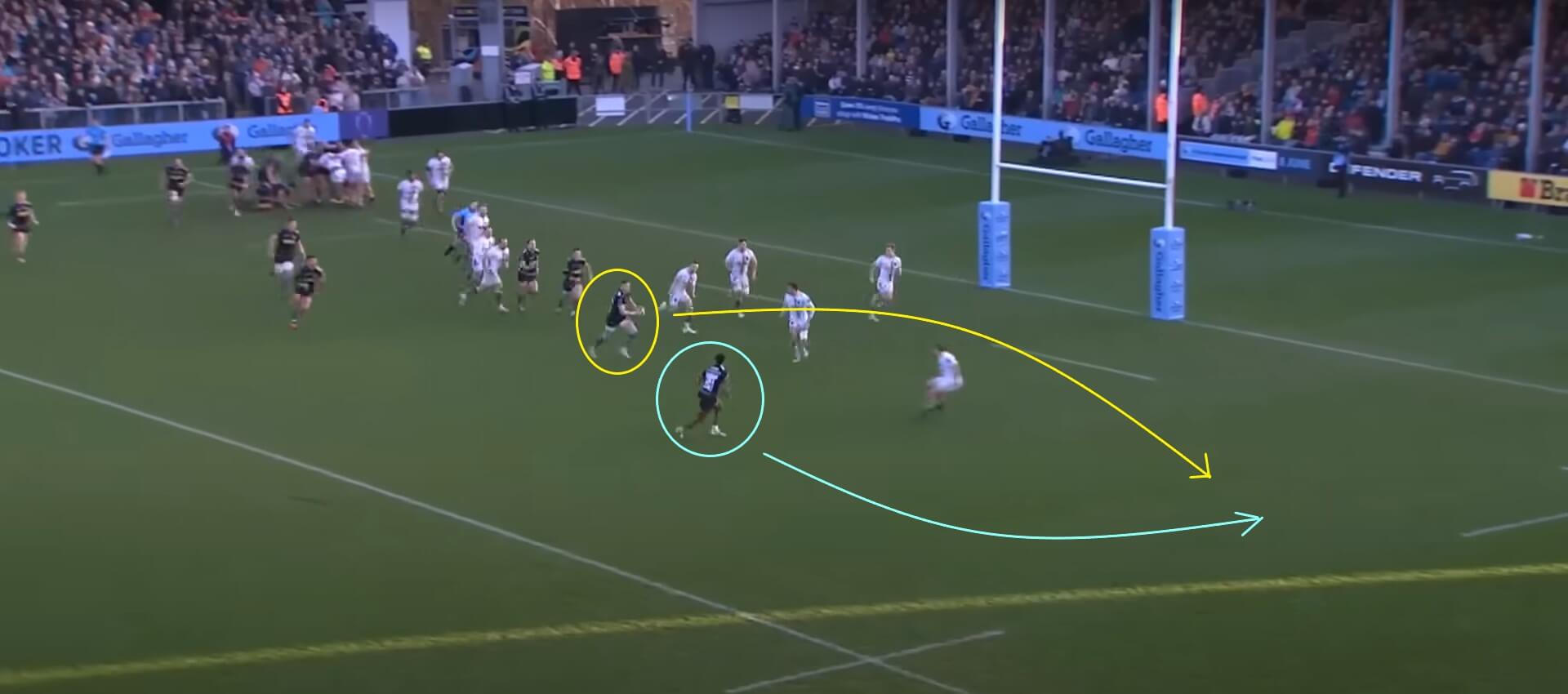
In this case, Feyi-Waboso’s positioning has forced Northampton Saints to also move towards the middle of the field, with the result being that fly-half Harvey Skinner is able to feed the ball towards the wing and his teammate is able to catch the Saints out to score.

His ability to make sharp changes of direction in that manner has been shown in other ways too, such as when he is making more direct attacking runs and breaking opponents down in more conventional ways. In this case, he has once again drifted inside the pitch to get on the ball, but this time he has tucked in behind it rather than looking to turn and run back out towards the wing.
By doing so, his aim is to get on the ball and to break through the opposing line with momentum, and it works to perfection here as he first dummies a pass towards captain and Wales lock Daffyd Jenkins and then runs between Bristol Bears flanker Dan Thomas and France centre Virimi Vakatawa, neither of whom is able to halt his progress.
On this occasion, he wasn’t able to complete the action by securing the try, with him being tackled just short of the line by lock James Dun, but his decisiveness and ability to evade the attempts to bring him down before then had had the desired impact and that is the key point, with scrum-half Stu Townsend having the relatively simple task of dotting the ball over to score the try but Feyi-Waboso receiving the plaudits for his efforts in the build-up to it.
Defensive play
It was mentioned that Immanuel Feyi-Waboso has been especially important for his team when they have been in possession, but that is not to say that he has been any less effective when the Chiefs have not had it, with him proving to be just as big an obstacle for opposing sides to negotiate.

Once again, his strength and physicality has come in useful here, with him standing strong and involving himself in defensive matters in order to make it as difficult as possible for opponents to gain territory. In this case, it is Northampton who are looking to fashion a try-scoring opportunity, with them shifting the ball towards the wing in their usual manner, and the two players now looking to take it forward towards the line are England scrum-half Alex Mitchell and former Worcester Warriors standoff Fin Smith.
Initially, they were met by ex-Ospreys flanker Ethan Roots, who is another player known for his ability to win duels such as this, but Exeter don’t start to push the duo back until Feyi-Waboso lends his support to the New Zealander, and the combination of the two leads to a counter ruck which succeeds in forcing Northampton to concede possession.
Feyi-Waboso did undo his good work very quickly here by picking up the ball from an offside position as soon as he had broken away from the drive, handing the Saints the chance to immediately reignite their attack, but the fact that he showed the same determination and desire here as he did at the other end of the pitch is something that cannot be denied.

This is not to say that he is perfect though, and, as referenced at the beginning of the scout report, there are things that he can still work on as his career progresses. One of the major issues in his play so far has been his tendency to be a little naïve at times when attempting to win the ball back, with there being times when he has moved out of line in his haste to regain it and has left his team too open as a result. In this case, he has noticed how London Scottish are passing the ball towards the far side wing and has looked to close it down, but centre Hayden Hyde has noticed this and attacks the gap that he has left open behind him instead, with Feyi-Waboso unable to react in time.
The fact that that move ended in the English Championship side scoring a try through substitute scrum-half Steven Kerins shows how dangerous this can be, and the fact that lapses in line discipline like this have occurred since then in league matches against Gloucester and Northampton shows how it is something that he will need to work on as he continues to gain more experience at this level, because it is moments like that that could make the difference between Exeter securing a play-off spot and them falling just short.
Potential England positions
This is not to say that Immanuel Feyi-Waboso is not ready for an international call-up though, because there has been more than enough in his performances so far to suggest that he would be able to cope with the demands of the world stage.
The question though is where England should deploy him when he does eventually make his bow, because, as mentioned, he can operate at centre as well as on the wing and the points made in this analysis have shown that he is an effective operator inside the pitch as well as in the wide channel.
It may well be that Borthwick tries him out in both positions to see where he is at his most effective and where he can play a part in his game plan, and it is not out of the question that he could also be used in other roles too, such as at full-back, given that the former Leicester Tigers head coach has been known to experiment with his lineups (the decision to start Harlequins playmaker Marcus Smith at full-back during last year’s Rugby World Cup is a prime example of that).
However, where it is perhaps more likely is to see him at the moment is on the wing, especially with captain Owen Farrell, who is known for his quick handling when on top form, absent for the time being and his current back-ups George Ford and Smith more known for their kicking than their work with the ball in hand.
As a result, England might opt to bring Saracens’ Elliott Daly, who has tended to play on the wing for the national team, into an inside centre role to give them a way of maintaining that quick passing, which might then open up a space for Feyi-Waboso to then feature on the wing, especially since the long-serving Jonny May retired following the conclusion of the World Cup.
In short though, there are a number of possibilities that England could consider, and it will be interesting to see where Borthwick sees him as featuring in his plans and how soon he gives him a chance to show what he can do.
Conclusion
In conclusion, this tactical analysis has taken a closer look at Exeter Chiefs back Immanuel Feyi-Waboso, identifying the reasons that he has attracted so much attention this season and has been heavily discussed with regards to international inclusion.
From the analysis, it is clear to see that he is a player who offers a lot of different qualities on the field, with him combining an expert finishing ability with the pace, precision and physicality of a marauding centre, and it is that that has given Exeter so many options tactically and the opportunity to find new ways to break opponents down as they seek to restore their reputation as the top club in the English Premiership.
The season is only at the halfway stage and there is still a lot of rugby left to play, whilst the European Rugby Champions Cup will also present a chance for Exeter to achieve glory this season. If they are to meet their pre-season targets and get their hands on silverware, then they will need their key players to be in form for as long as possible. Despite this being his first season as a regular in the starting XV, Feyi-Waboso has quickly established himself as one of those, and the Chiefs will be depending on him to maintain his performance levels as the games continue to come.